Transportation technology is one of the most visible and transformative components of technological evolution. It determines how people, goods, resources, and ideas move across space, shaping economies, cultures, and the structure of societies. From simple human-powered movement to complex mechanised systems, transportation technology reflects humanity’s ongoing effort to overcome distance, time, and physical limits.
This article examines how transportation technology evolved, tracing its progression from early movement solutions to integrated, energy-driven systems that support modern civilization.
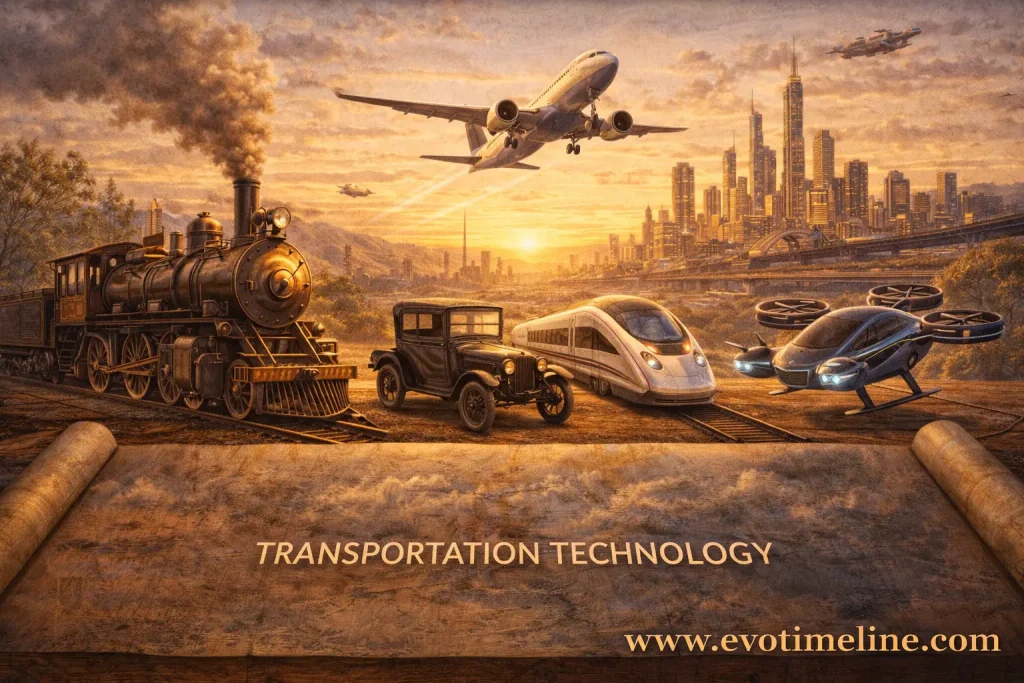
Table of Contents
Understanding Transportation Technology
Transportation technology refers to the tools, vehicles, infrastructure, and systems developed to move people and materials efficiently and reliably. It combines multiple technological domains, including energy, materials, mechanics, and control systems.
Core characteristics of transportation technology include:
- Mobility and reach
- Load capacity and efficiency
- Energy dependence
- Infrastructure integration
- Safety and reliability
Transportation technology evolves in direct response to social needs, geographic constraints, and available energy sources.
Early Human Movement
The earliest transportation technology relied entirely on human physical capability.
Walking and Carrying
Human movement was the original transportation system. Tools such as baskets, sledges, and simple carriers extended carrying capacity and reduced physical strain.
These early solutions emphasized:
- Efficiency of effort
- Load distribution
- Adaptation to terrain
They set the conceptual foundation for later transportation systems.
Animal-Powered Transportation
The domestication of animals marked a significant advancement in transportation technology.
Pack and Draft Animals
Animals enabled humans to move heavier loads over longer distances. This expanded trade, agriculture, and settlement patterns.
Animal-powered transportation introduced:
- Greater speed and endurance
- Increased carrying capacity
- Early transport specialization
This stage demonstrates how transportation technology evolves by amplifying available energy sources.
The Wheel and Ground Transport
One of the most influential developments in transportation technology was the wheel.
Wheeled Vehicles
Wheeled transport reduced friction and made long-distance land movement more practical. It enabled carts, wagons, and later complex vehicle systems.
The wheel represents a fundamental technological principle: mechanical efficiency through design.
Water-Based Transportation
Water transport allowed movement at scales impossible on land.
Boats and Navigation
Floating vessels enabled the transportation of large loads using relatively low energy. Rivers, seas, and oceans became transportation networks connecting distant regions.
Water-based transportation introduced:
- Trade networks
- Cultural exchange
- Early navigation systems
It remains one of the most energy-efficient transportation methods.
Mechanical Transportation Systems
As technology advanced, transportation became increasingly mechanized.
Mechanized Land Transport
Mechanical power replaced animal labor, increasing speed, reliability, and scale. Vehicles became less dependent on biological limits and more reliant on engineered systems.
This stage reflects the transition from organic to mechanical mobility.
Transportation in the Industrial Era
Industrial technology transformed transportation fundamentally.
Rail-Based Systems
Mechanized rail systems allowed heavy loads to be transported rapidly over long distances. This reduced travel time, connected markets, and reshaped economic geography.
Industrial transportation emphasized:
- Standardized infrastructure
- Scheduled movement
- High-volume transport
Transportation systems became tightly linked to industrial production.
Energy and Transportation Technology
Transportation technology evolves alongside energy technology.
- Animal power → biological energy
- Mechanical systems → thermal energy
- Modern systems → electrical and fuel-based energy
Energy availability determines speed, range, and capacity, making energy systems a critical constraint in transportation evolution.
Infrastructure and Transportation Networks
Transportation technology depends on supporting infrastructure.
Infrastructure includes:
- Roads and pathways
- Ports and terminals
- Control and safety systems
As transportation systems scale, infrastructure becomes as important as the vehicles themselves, shifting focus from isolated tools to networked systems.
Electrical and Automated Transportation
Electrical technology introduced new forms of transportation control and efficiency.
Electrified Transport
Electric systems allowed smoother operation, reduced mechanical complexity, and improved control. Electrification also enabled integration with broader energy networks.
Automation introduced:
- Reduced human error
- Increased scheduling precision
- System-level optimization
These developments reflect growing technological integration.
Transportation in the Digital Era
Digital technology reshaped transportation through data, control, and coordination.
Digital systems enabled:
- Route optimization
- Traffic management
- System monitoring
Transportation became increasingly information-driven, not just mechanically driven.
Emerging Transportation Systems
Modern transportation technology emphasizes:
- Efficiency and optimization
- Integration with energy systems
- Adaptive and intelligent control
Emerging transportation systems reflect broader technological trends toward convergence, automation, and system intelligence.
Social and Economic Impact
Transportation technology reshapes societies by:
- Expanding trade and interaction
- Enabling urbanization
- Influencing labor and production
Changes in transportation often trigger broader technological and social transformations.
Limitations and Constraints
Transportation technology faces persistent constraints:
- Energy consumption
- Environmental impact
- Infrastructure cost
- Safety requirements
These constraints drive continuous innovation rather than static solutions.
Transportation Technology in the Evolutionary Timeline
Transportation technology evolves in parallel with other technological domains:
- Ancient Technology → human and animal movement
- Industrial Technology → mechanized transport
- Electrical Technology → controlled mobility
- Digital Technology → intelligent systems
- Emerging Technology → integrated transportation networks
Each stage builds upon earlier solutions.
Why Transportation Technology Matters
Transportation technology determines:
- How fast societies grow
- How widely are resources spread
- How technologies interact
It acts as the circulatory system of civilization, connecting all other technological systems.
Conclusion: Transportation Technology as a Driver of Progress
Transportation technology is not merely about movement; it is about connection, scale, and possibility. By overcoming distance and physical limitations, transportation systems enable trade, communication, and technological integration.
Within the evolution of technology, transportation serves as both a catalyst and an amplifier, turning local innovations into global systems. From early human movement to complex, networked mobility, transportation technology reflects humanity’s enduring drive to move farther, faster, and more efficiently.
Transportation technology does not just move people and goods—it moves civilization itself.