Technology timelines provide a structured way to understand the evolution of technology across human history. Rather than viewing technology as isolated inventions, timelines reveal how tools, systems, and ideas developed progressively—each stage building upon earlier foundations.
This article explains what technology timelines are, why they matter, and how they help make sense of technological change from ancient tools to modern and emerging systems.
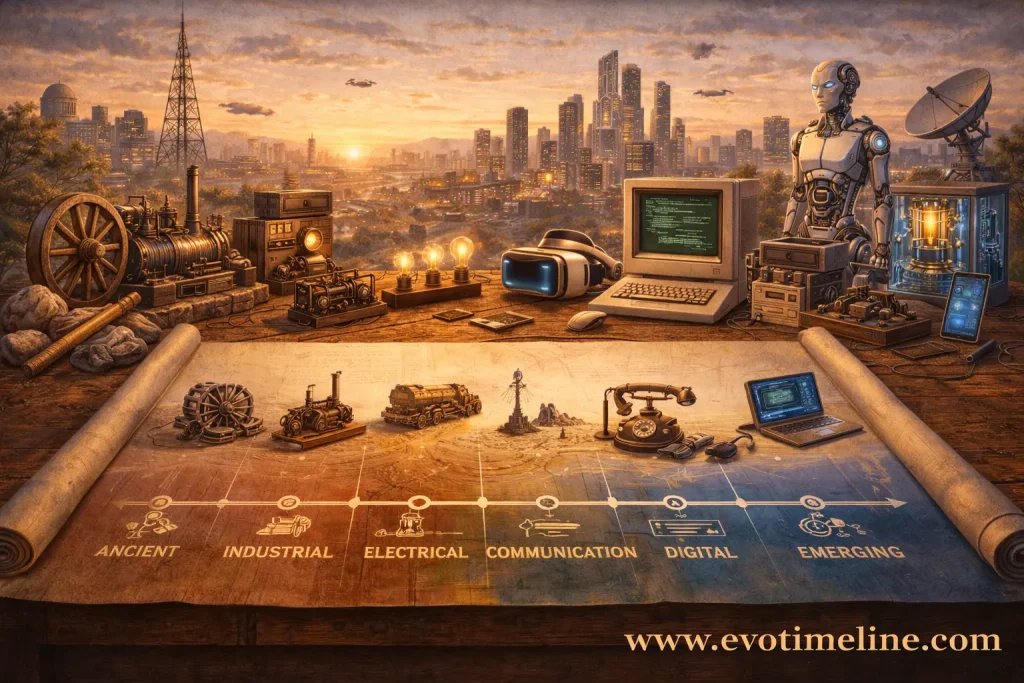
Table of Contents
What Are Technology Timelines?
A technology timeline is a chronological framework that organizes technological developments according to time, stages, and transitions. It focuses on progression, not just events.
Technology timelines emphasize:
- Sequence rather than isolation
- Development rather than invention
- Continuity rather than disruption
They show how technologies evolve through phases such as emergence, refinement, expansion, and transformation.
Why Timelines Matter in Technology History
Without timelines, technological history appears fragmented. Timelines provide context and coherence.
They help us:
- Understand cause-and-effect relationships
- See how one technology enables another
- Identify patterns of growth and decline
- Compare different technological eras
Timelines transform history into a narrative of evolution.
The Earliest Technology Timelines: Survival to Settlement
The first phase of technological timelines begins with ancient technology, where survival needs shaped innovation.
Key milestones include:
- Toolmaking
- Fire control
- Early agriculture
- Basic construction
This stage shows how technology evolved slowly through experimentation and adaptation.
Mechanization and the Industrial Timeline
The industrial era marks a sharp acceleration in technological timelines.
Key transitions include:
- Manual labor → mechanized production
- Craft systems → factory systems
- Local production → large-scale output
Industrial technology timelines highlight how energy use, machinery, and organization reshaped society.
Electrification and Network Timelines
Electrical technology introduced a new timeline centred on power distribution and connectivity.
Major developments include:
- Centralized power generation
- Transmission networks
- Electrified industry and cities
This era demonstrates how technology shifted from localized systems to interconnected infrastructures.
Communication Technology Timelines
Communication timelines trace the evolution of information transmission.
Progression typically follows:
- Visual and symbolic communication
- Written systems
- Mechanical reproduction
- Electrical signaling
- Digital communication
These timelines show how societies reduced the time and effort required to share information.
Digital Technology Timelines
Digital technology timelines focus on information processing and data systems.
Key stages include:
- Mechanical computation
- Electronic logic systems
- Programmable machines
- Networked digital systems
This timeline highlights a shift from physical processes to abstract, data-driven systems.
Energy Technology Timelines
Energy timelines cut across all technological eras.
They track transitions such as:
- Human and animal power
- Mechanical energy
- Electrical energy
- Advanced energy systems
Energy timelines explain why certain technologies became dominant and others faded.
Convergence in Modern Timelines
Modern technology timelines increasingly show convergence, where multiple technologies merge.
Examples include:
- Digital systems controlling physical machines
- Communication networks embedded in infrastructure
- Energy systems managed by intelligent control
This stage reflects the growing complexity of technological systems.
Timelines vs. Isolated Innovation
Technology timelines challenge the myth of sudden breakthroughs.
They show that:
- Innovations are cumulative
- Most change is incremental
- Disruptions are usually rapid transitions within longer trends
Timelines reveal that technological progress is structured, not random.
How EvoTimeline Uses Technology Timelines
At EvoTimeline, timelines are the site’s structural backbone.
Each timeline:
- Connects multiple categories
- Shows progression across eras
- Acts as a navigation tool for readers
- Supports deep internal linking
Timelines help readers move seamlessly between:
- Ancient Technology
- Industrial Technology
- Electrical Technology
- Communication Technology
- Digital Technology
- Emerging Technology
- Energy Technology
Reading Technology Timelines Correctly
To interpret a technology timeline effectively:
- Focus on transitions, not just dates
- Identify enabling technologies
- Observe recurring concepts (efficiency, automation, scalability)
- Compare parallel developments across categories
Timelines are tools for understanding processes, not memorizing events.
The Role of Timelines in Technological Evolution
Technology timelines reveal a central truth:
Technology evolves through continuity, not replacement.
Each era:
- Inherits principles from earlier stages
- Refines existing systems
- Creates conditions for future development
Timelines make this continuity visible.
Technology Timelines and the Future
While timelines describe the past and present, they also help frame future understanding—without prediction or speculation.
By recognizing:
- Repeating patterns
- Common constraints
- Evolutionary cycles
We gain a grounded perspective on how technology continues to evolve.
Conclusion: Technology Timelines as a Framework for Understanding
Technology timelines are more than historical tools—they are analytical frameworks that reveal how innovation unfolds over time. By organizing technological development into coherent sequences, timelines transform scattered information into meaningful insight.
Within the evolution of technology, timelines show that progress is cumulative, interconnected, and concept-driven. They allow us to see technology not as a series of inventions, but as a continuous human endeavor shaped by needs, resources, and ideas.
Technology timelines turn history into understanding—and understanding into perspective.