Industrial technology marks one of the most significant turning points in the evolution of technology. It represents the transition from hand-based, small-scale production to machine-driven, large-scale systems that reshaped economies, societies, and daily life. Unlike ancient technology, which relied primarily on human and animal power, industrial technology introduced mechanical energy, standardised processes, and organised manufacturing.
This article explores how industrial technology emerged, evolved, and fundamentally changed the way humans work, produce, and live.
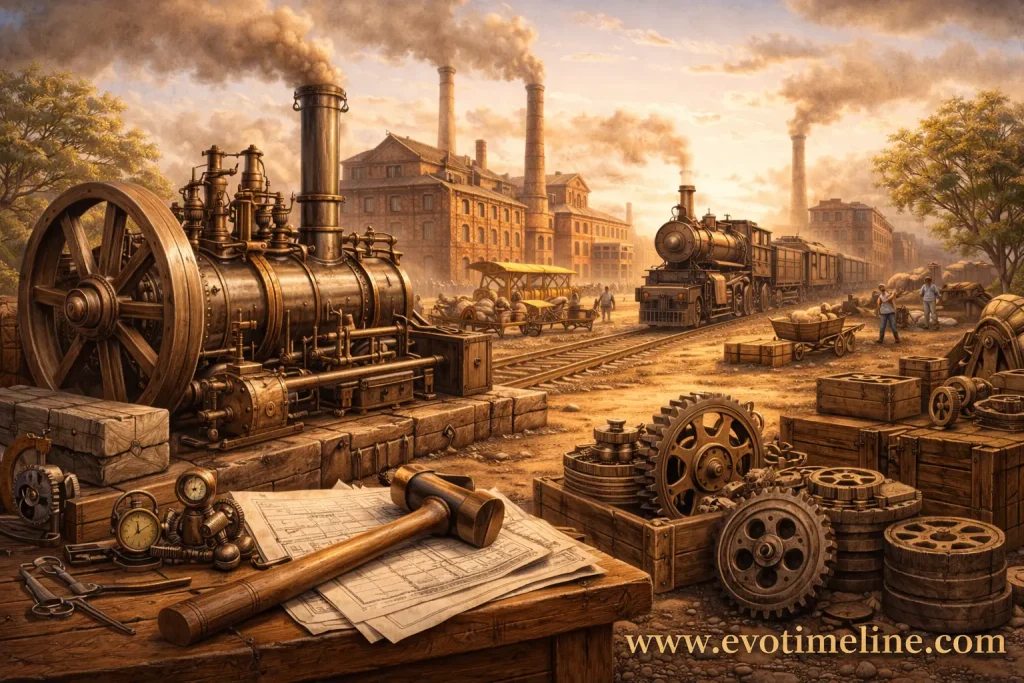
Defining Industrial Technology
Industrial technology refers to the tools, machines, systems, and processes developed to mechanize production and increase efficiency. Its core objective was to reduce human labour while increasing output, consistency, and speed.
Key characteristics of industrial technology include:
- Use of mechanical power
- Standardization of tools and processes
- Centralized production facilities
- Division of labor
- Continuous technological improvement
Industrial technology did not appear suddenly; it evolved gradually from earlier mechanical and craft-based innovations.
Pre-Industrial Roots of Mechanization
Before the onset of the industrial era, societies experimented with proto-industrial technologies.
Craft Production and Workshops
For centuries, goods were produced in small workshops using hand tools. Skilled artisans controlled the entire production process, from raw material to finished product. While efficient for limited demand, this system could not scale easily.
Early Mechanical Devices
Simple machines such as waterwheels, windmills, and mechanical looms introduced non-human power sources into production. These technologies demonstrated that natural energy could be harnessed to perform repetitive tasks, paving the way for industrialization.
The Rise of Mechanical Power
The defining feature of industrial technology was the use of mechanical power to drive machines.
Steam Power
Steam engines transformed industrial activity by providing a reliable and controllable energy source. Unlike water or wind, steam power could operate continuously and be deployed almost anywhere.
Steam-powered machinery enabled:
- Faster production
- Larger factories
- Expanded transportation networks
Steam technology became the backbone of early industrial systems.
Machinery and Factory Systems
Industrial technology introduced machines designed for specific, repetitive tasks.
Specialized Machines
Machines replaced manual processes in spinning, weaving, metalworking, and other industries. These machines were engineered for precision and speed, reducing dependence on skilled manual labour.
Factory Organization
The factory system centralized workers, machines, and materials in a single location. This allowed:
- Better supervision
- Consistent workflows
- Higher productivity
However, it also transformed labour into a more regimented and time-bound activity.
Transportation and Industrial Expansion
Industrial technology extended beyond factories into transportation systems.
Railways and Mechanized Transport
Steam-powered locomotives and mechanized shipping dramatically reduced transportation time and cost. Raw materials could be moved efficiently, and finished goods could reach distant markets.
Transportation technology became integral to industrial systems, enabling large-scale production to function effectively.
Materials and Manufacturing Processes
Advancements in industrial technology depended heavily on materials innovation.
Metalworking and Toolmaking
Improved methods for producing iron and steel allowed for stronger machines, tools, and infrastructure. Precision tools enabled machines to build other machines, accelerating technological progress.
Standardization
Industrial production emphasized standardized parts and measurements. This allowed components to be interchangeable, reducing repair time and increasing efficiency.
Standardization represents a key shift in technological thinking—from craftsmanship to system optimization.
Energy Systems in Industrial Technology
Industrial technology expanded the use of energy beyond mechanical motion.
Coal and Fuel-Based Systems
Fossil fuels became primary energy sources, powering engines, furnaces, and transportation. Energy availability became directly linked to industrial capacity.
This marked the beginning of energy-intensive technological systems, a trend that continues in modern technology.
Social and Economic Impact
Industrial technology reshaped society as much as it transformed production.
Labor Transformation
Work shifted from home-based or agricultural settings to factories. Skills became specialised, and labour was divided into narrowly defined tasks.
Urbanization
Factories attracted workers, leading to rapid urban growth. Cities became centres of technological activity, innovation, and economic exchange.
Industrial technology thus influenced not only how things were made, but how societies were organized.
Technological Evolution Within Industry
Industrial technology was not static; it evolved through continuous refinement.
- Machines became more efficient
- Power systems improved
- Production processes were optimized
Feedback between invention and application created a cycle of self-reinforcing innovation, accelerating technological change.
Limitations and Challenges
Despite its success, industrial technology had inherent limitations:
- Heavy reliance on fossil fuels
- Environmental impact
- Rigid production systems
- Human labor displacement
These challenges later motivated further technological evolution, including the development of electrical and digital technologies.
Industrial Technology as a Foundation
Industrial technology laid the groundwork for later technological phases:
- Electrical technology is built upon industrial infrastructure
- Mass production enabled electronic manufacturing
- Industrial systems influenced modern automation
In this sense, industrial technology acts as a bridge between ancient mechanical innovation and modern technological systems.
Conclusion: Industrial Technology in the Evolutionary Timeline
Industrial technology represents a critical stage in the evolution of technology, where human ingenuity shifted from manual skill to mechanized systems. It introduced new ways of thinking about production, energy, and efficiency—concepts that continue to shape technological development today.
By transforming how goods were made, moved, and distributed, industrial technology redefined the relationship between humans and machines. Its legacy remains embedded in modern manufacturing, transportation, and energy systems, making it an essential chapter in the technological timeline.